
Acne Scar Treatment in Bangalore: What Actually Works?
If your acne has finally settled but the marks, pits or uneven texture are still there, you are not alone.
This is actually one of the most common reasons people start looking for acne scar treatment in Bangalore.
And one of the first things worth knowing is this:
Not every mark left by acne is an acne scar.
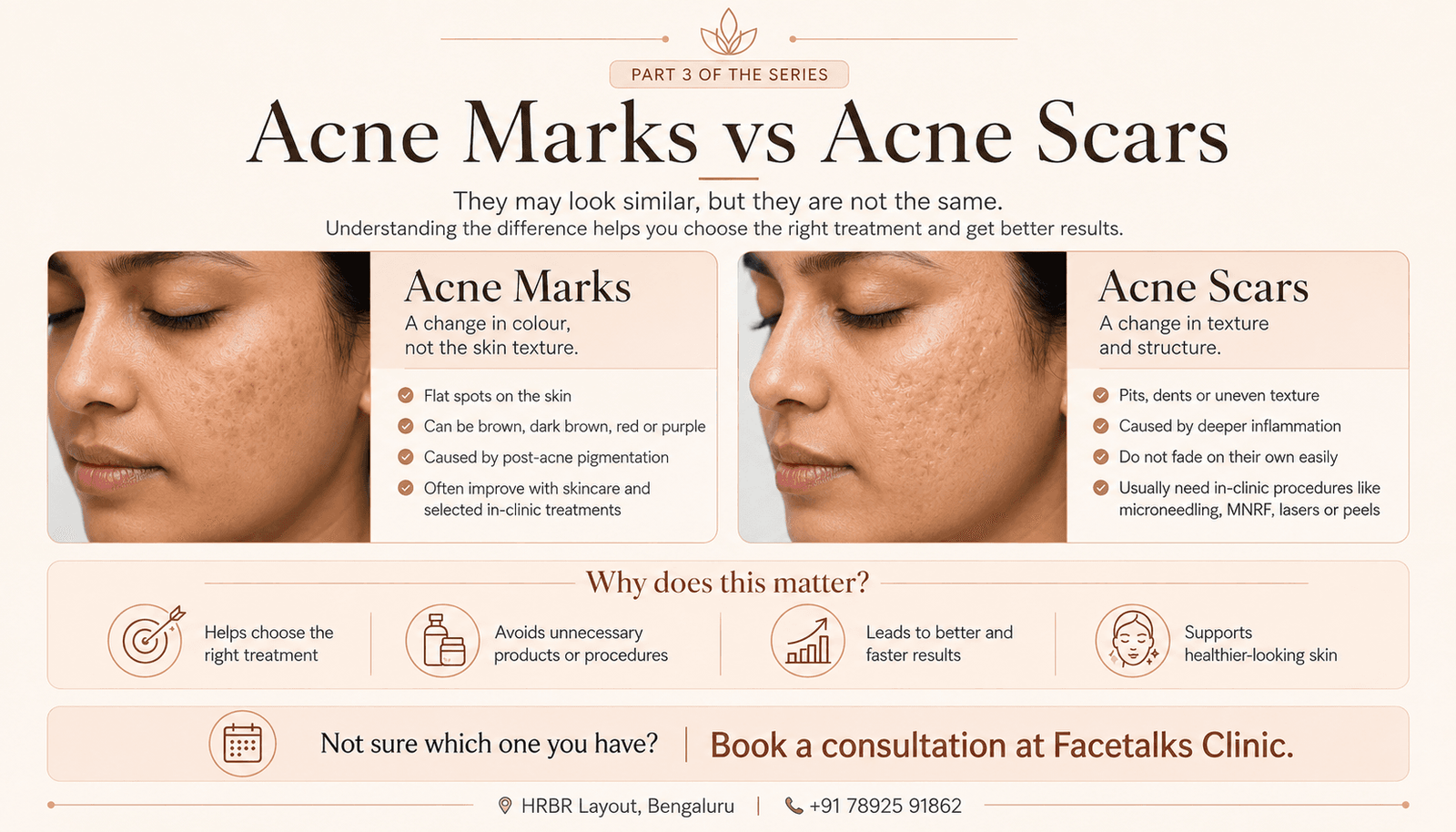
A flat brown or dark mark after a pimple is usually pigmentation. A dip, dent or change in the texture of the skin is more likely to be an actual scar.
They may look similar from a distance, but they don’t always need the same treatment.
That is why choosing a treatment based only on an Instagram reel, advertisement or something that worked for a friend isn’t usually the best approach.
The first step is understanding what kind of acne scar you have.
Why Do Acne Scars Form?
Acne causes inflammation inside the skin.
When deeper acne lesions heal, the skin tries to repair the damaged tissue by producing collagen. If too little collagen is produced, the skin can heal with a depression or pit. In some people, excess tissue can instead result in a raised scar.
Picking or squeezing active pimples may also increase inflammation and the possibility of marks or scarring.
This is also why treating active acne early is important. There is little benefit in treating scars repeatedly while new inflammatory acne continues to create new ones.
Acne Marks and Acne Scars Are Different
This distinction is important because we regularly see people referring to every dark spot after acne as a “scar.”
Acne marks
These are usually flat areas of pigmentation left behind after inflammation.
They may appear:
- Brown
- Dark brown
- Red
- Purple
- Greyish on deeper Indian skin tones
Depending on the pigmentation, treatments may include appropriate skincare, chemical peels or selected laser-based treatments after assessing the skin.
Acne scars
True scars change the texture or structure of your skin.
Creams and serums may improve your overall skin quality, but deeper structural acne scars often require in-clinic procedures to create a noticeable improvement.
What Type of Acne Scar Do You Have?
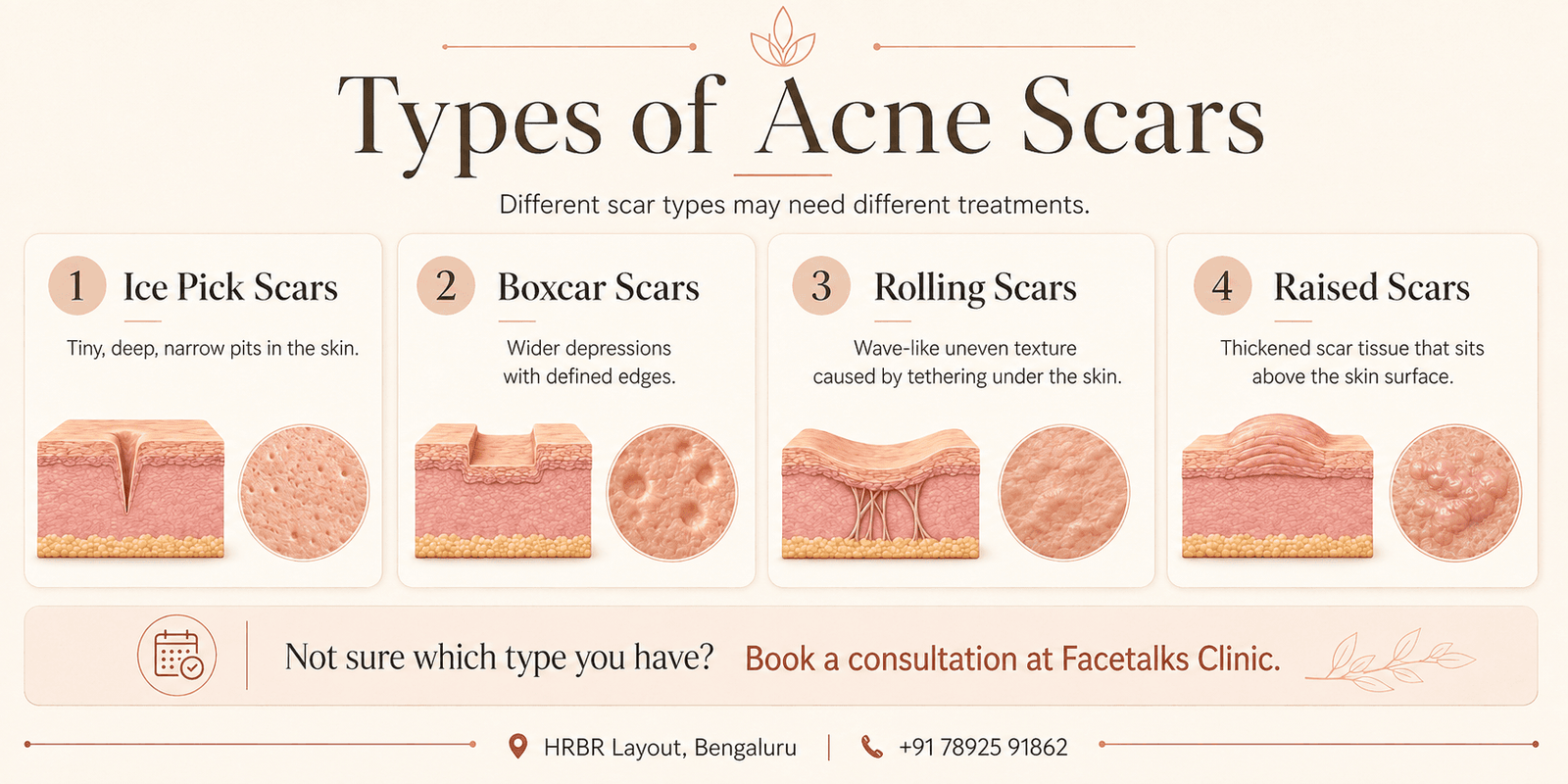
You may have more than one scar type at the same time.
Ice-pick scars
These look like tiny but deep holes in the skin.
They are narrow at the surface and extend deeper into the skin, which can make them more difficult to treat with superficial treatments alone.
Boxcar scars
Boxcar scars are wider depressions with more defined edges.
Some are shallow, while others can be considerably deeper.
Rolling scars
Rolling scars tend to create a wavy or uneven appearance because the scar may be tethered to deeper tissue.
Raised scars
Some acne scars grow above the surrounding skin instead of creating a depression. These need a different treatment approach from depressed scars.
Because scar types behave differently, the best acne scar treatment isn’t necessarily one single procedure for everyone.
So, What Is the Best Acne Scar Treatment in Bangalore?
There isn’t one universal answer.
The right treatment depends on factors such as:
- Your scar type
- How deep the scars are
- Whether you still have active acne
- Your skin tone
- Existing pigmentation
- Previous treatments
- Downtime you are comfortable with
- Your expected outcome
At , treatment planning begins with assessing the skin rather than immediately choosing a procedure.
Here are some of the treatment approaches that may be considered.
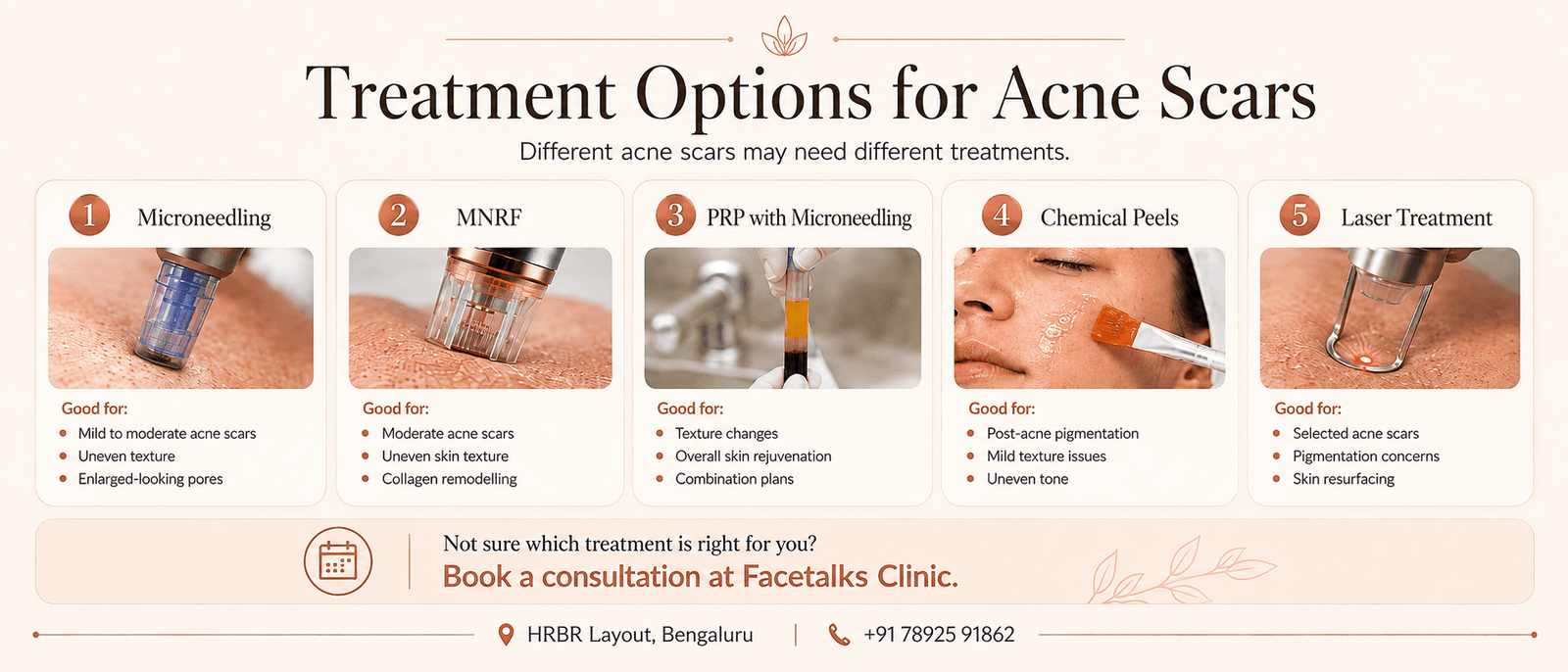
1. Microneedling for Acne Scars
Microneedling uses very fine needles to create controlled micro-injuries in the skin.
This encourages the skin’s natural repair process and collagen production.
The American Academy of Dermatology lists acne scars among the conditions dermatologists treat with microneedling, and notes that it may also be combined with treatments such as radiofrequency or platelet-rich plasma.
Microneedling may be considered when someone has:
- Uneven skin texture
- Mild to moderate depressed acne scars
- Enlarged-looking pores
- A combination of scars and textural concerns
Results are gradual rather than overnight because collagen remodelling takes time.
2. MNRF for Acne Scars
Microneedling Radiofrequency, or MNRF, combines microneedling with controlled radiofrequency energy delivered within the skin.
The aim is to stimulate collagen remodelling at controlled depths.
MNRF may be recommended for certain depressed acne scars, uneven texture and related concerns after examining the skin.
Facetalks already provides MNRF among its aesthetic treatment options.
One advantage of an individual assessment is that the needle depth and treatment plan can be selected according to the scar rather than applying exactly the same protocol to every face.
3. PRP With Microneedling
PRP stands for platelet-rich plasma.
During PRP treatment, a small amount of the patient’s own blood is processed to concentrate platelets, which can then be used as part of certain aesthetic procedures.
For acne scars, PRP may sometimes be combined with microneedling rather than being used as a replacement for scar treatment itself.
The American Academy of Dermatology notes that microneedling is sometimes combined with platelet-rich plasma to improve treatment outcomes.
Whether this combination makes sense for you depends on your scars and the treatment plan recommended after consultation.
4. Chemical Peels for Acne Marks and Selected Scars
Chemical peels remove controlled layers of damaged surface skin using carefully selected acids.
They can be useful when acne has left:
- Pigmentation
- Dullness
- Uneven tone
- Mild textural irregularities
Different acids and concentrations behave very differently, so this isn’t something where “stronger” automatically means “better.”
DermNet includes chemical peeling among procedures used in acne-scar management, while also noting that multiple treatments may be required to obtain the best achievable improvement.
For deeper pits, however, a peel alone may not be enough.
5. Laser-Based Treatments
Laser treatments are another option used for certain acne scars, pigmentation and uneven skin texture.
Different lasers work in very different ways.
Some target pigmentation, while resurfacing lasers are designed to create controlled injury that encourages new collagen formation.
This is why simply asking for “laser for acne scars” doesn’t tell the full story.
Your skin tone, scar depth, pigmentation tendency and the exact laser technology being used all matter.
Facetalks offers advanced laser-based aesthetic treatments including Pico Laser, and an assessment can determine whether a laser treatment is appropriate for your particular concern.
Can Acne Scars Be Removed Completely?
This is probably the question people ask most.
A better goal is usually improvement rather than promising complete removal.
How much improvement is possible varies from person to person.
Someone with shallow scars and pigmentation may respond differently from someone with deep ice-pick and rolling scars that have been present for many years.
In many cases, scar treatment is a process rather than a one-session procedure.
Dermatology guidance also notes that multiple treatments may be necessary when treating acne scars.
A good consultation should therefore explain:
- What type of scars you have
- Which treatment is being recommended
- Why it is being recommended
- Likely downtime
- Approximate number of sessions
- Expected improvement
- Possible risks and side effects
Be cautious of anyone promising that every acne scar will disappear after a single session.
How Many Sessions Will I Need?
There is no fixed number that works for everyone.
Your treatment schedule may depend on:
Scar severity: Deeper scars generally need more work than mild texture changes.
Type of procedure: Microneedling, MNRF, peels and laser treatments have different recommended intervals.
Skin response: Collagen formation and healing vary between individuals.
Combination treatment: Some patients may benefit from combining different treatments because they have several types of scars.
You should receive a clearer estimate after your skin has been assessed in person.
Is Acne Scar Treatment Painful?
This depends on the procedure.
For treatments such as microneedling or MNRF, a topical numbing cream may be used beforehand to improve comfort.
Some procedures can cause temporary:
- Redness
- Mild swelling
- Sensitivity
- Dryness
- Peeling
Downtime varies considerably depending on the intensity and type of treatment.
If you have an important event coming up, mention it during your consultation so the treatment can be planned appropriately.
What Should You Avoid After Acne Scar Treatment?
Aftercare varies according to the procedure, but protecting healing skin is important.
Your clinician may advise you to:
- Use sunscreen regularly
- Avoid unnecessary direct sun exposure
- Avoid picking or scratching treated skin
- Use gentle skincare
- Temporarily stop certain active ingredients
- Follow the prescribed post-treatment routine
Don’t immediately add several new skincare products just because the skin looks dry or irritated after treatment.
Follow the instructions given for your specific procedure.
Why Acne Scar Treatment for Indian Skin Needs Careful Planning
Indian skin tones can develop post-inflammatory pigmentation after irritation or inflammation.
That doesn’t mean procedures cannot be performed safely.
It means parameters, treatment choice and aftercare need to be selected carefully.
Skin colour, recent tanning, existing pigmentation and history of pigmentation should therefore be considered before performing aggressive procedures.
Personalisation matters much more than following a standard “three-session package” for everyone.
Acne Scar Treatment in Kalyan Nagar & HRBR Layout
If you are searching for acne scar treatment near Kalyan Nagar, HRBR Layout, Kammanahalli, Hennur or Banaswadi, Facetalks Clinic is located on 100 Feet Road in HRBR Layout 1st Block.
Instead of deciding on a treatment before seeing your skin, you can start with a consultation and understand whether the concern is:
- Active acne
- Post-acne pigmentation
- Ice-pick scars
- Boxcar scars
- Rolling scars
- Enlarged pores
- Uneven texture
- Or a combination of these
From there, an appropriate treatment plan can be discussed based on your skin and expectations.
When Should You Consider Seeing a Skin Professional?
You don’t need to wait until acne scars become severe.
Consider having your skin assessed if:
- Your acne keeps leaving pits
- Dark acne marks are not fading
- Your skin texture bothers you even after acne has settled
- You have already tried several creams without improvement
- You aren’t sure whether you have pigmentation or actual scars
- You want to understand the available procedural treatments before spending money on them
Getting the diagnosis right first can save you months of experimenting with treatments that were never suited to your type of scar.
Looking for Acne Scar Treatment in Bangalore?
Acne scars can be frustrating, especially when the acne itself has disappeared but its reminders haven’t.
The good news is that there are now several treatment options available.
The important part is not chasing the latest trending procedure.
It is finding the right treatment for your scar type, skin tone and goals.
Book an Acne Scar Consultation at Facetalks Clinic
If you would like to understand which treatment may suit your acne scars, you can book a consultation with the Facetalks Clinic team.
Facetalks Clinic – HRBR Layout
1st Floor, 228, 100 Feet Rd
HRBR Layout 1st Block
Kalyan Nagar, Bengaluru, Karnataka 560043
Call / WhatsApp: +91 78925 91862
CTA: Book Your Skin Consultation
Frequently Asked Questions
Which treatment is best for acne scars?
There is no single best treatment for every acne scar. Microneedling, MNRF, chemical peels, laser-based treatments and combination approaches may be considered depending on the type and depth of the scars.
Does microneedling work for acne scars?
Microneedling is used by dermatologists to improve certain acne scars by stimulating the skin’s repair and collagen-remodelling response. The number of sessions required varies between patients.
How long does acne scar treatment take to show results?
Some surface changes may appear earlier, but treatments that rely on collagen remodelling generally produce gradual changes over the following weeks and months. The timeline depends on the procedure and severity of the scars.
Can old acne scars be treated?
Older acne scars may still be treated. The appropriate treatment depends more on scar type, depth, skin condition and other individual factors than simply how long the scar has been present.
Are acne marks and acne scars the same?
No. Flat dark or red marks after acne are commonly post-inflammatory colour changes, whereas true acne scars alter the texture or structure of the skin.
Where can I get acne scar treatment near Kalyan Nagar?
Facetalks Clinic is located in HRBR Layout 1st Block on 100 Feet Road, Kalyan Nagar, Bengaluru, and provides consultations for skin and aesthetic concerns including acne scars.