

How Often Should You Get a Facial? A Practical Guide for Bangalore
 You get a facial.
Your skin feels cleaner, smoother and fresher.
Then a few weeks later, you start wondering:
When should I book the next one?
Every two weeks?
Once a month?
Only before an important event?
Or whenever your skin starts looking dull again?
Search online and you’ll probably come across the familiar advice:
“Get a facial every month.”
But your skin doesn’t work according to a fixed calendar.
Someone with oily and congested skin may need a completely different approach from someone with dry or sensitive skin. The type of facial also matters.
A gentle hydrating facial and an exfoliating treatment should not automatically be repeated at the same frequency.
So instead of asking only:
“How often should I get a facial?”
A better question is:
“How often does my skin actually need this particular facial?”
Let’s understand that properly.
Table of Contents
ToggleIs Once a Month the Ideal Facial Frequency?
You’ve probably heard that a professional facial should be done approximately once every month.
There is some logic behind using four to six weeks as a general starting point.
Cleveland Clinic notes that facial frequency depends on the skin concerns being treated and cites four to six weeks as a commonly suggested routine, with the frequency being reassessed once the skin concern is better managed.
But that doesn’t mean everybody needs a facial every four weeks.
Your ideal schedule depends on things such as:
- Your skin type
- Your current skin concerns
- The kind of facial you’re receiving
- How much exfoliation is involved
- Your home skincare routine
- Other skin treatments you’re undergoing
- How your skin responded to the previous facial
So think of once a month as a possible starting point—not a compulsory rule.
How Often Should You Get a Facial Based on Your Skin Type?
This is where facial scheduling becomes much more useful.

1. Oily and Congested Skin
Oily skin naturally produces more sebum.
You might notice:
- Frequent shine
- Blackheads
- Congested pores
- Rough-looking texture
- Occasional breakouts
Professional facials focused on cleansing and congestion may be useful as part of your skincare routine.
Depending on your skin, options such as HydraFacial or selected cleansing-focused facials may be considered.
How often?
Some people with oily or congested skin may start around every four to six weeks, then adjust according to how their skin responds.
But don’t assume more frequent exfoliation means cleaner skin.
The American Academy of Dermatology specifically warns that exfoliation frequency should depend on your skin type and the exfoliation method. More aggressive exfoliation generally needs to be done less frequently because over-exfoliation can leave skin red and irritated.
Important:
If you have painful, inflamed or persistent acne, repeatedly booking facials isn’t necessarily the solution.
Active acne may need proper assessment and treatment.
AAD also advises people with acne-prone skin to avoid aggressive scrubbing and irritating exfoliation because these can worsen irritation and breakouts.
2. Dry Skin
Dry skin may feel:
- Tight
- Rough
- Flaky
- Uncomfortable
- Less supple than usual
For dry skin, the goal generally isn’t to repeatedly strip away more surface skin.
Hydration and maintaining the skin barrier are usually more important.
A hydrating professional facial may help the skin feel softer and fresher.
How often?
You may not need frequent intensive treatments.
Depending on the facial and your skin condition, an interval of around four to six weeks or longer may be reasonable.
Your skin’s reaction after the previous session matters more than following a fixed calendar.
If your face remains irritated or unusually dry after a treatment, that is not a sign that you need another facial sooner.
It may mean you need a gentler approach.
3. Combination Skin
Combination skin can be confusing.
You may have:
Oily:
Forehead + nose + chin
while simultaneously having:
Normal or dry:
Cheeks
This means treating your entire face as oily can sometimes leave the cheeks uncomfortable.
How often?
Combination skin often benefits more from customisation than increased frequency.
A monthly or four-to-six-week facial may work for some people, but the facial itself should account for the different needs of each area.
Instead of simply asking:
“Can I book the same facial again?”
ask:
“How did my oily and dry areas respond last time?”
That provides much more useful information.
4. Sensitive Skin
Sensitive skin requires a more conservative approach.
If your skin commonly experiences:
- Burning
- Stinging
- Redness
- Irritation
- Reactions to new products
you should be careful about both what facial you choose and how frequently you repeat it.
Should sensitive skin have monthly facials?
Not automatically.
A gentle hydration-focused facial may suit some sensitive skin, while frequent exfoliating treatments may be too much for others.
AAD notes that people with sensitive skin may react more easily to exfoliation and recommends choosing methods based on individual skin type.
If you notice ongoing irritation, don’t schedule another treatment simply because four weeks have passed.
Allow the skin to settle and have it assessed if necessary.
5. Dull or Tired-Looking Skin
Dull skin is one of the most common reasons people book professional facials.
It may be associated with:
- Dehydration
- Surface buildup
- Dryness
- Uneven tone
- Sun exposure
- Irregular skincare
Depending on the cause, treatments such as:
- HydraFacial
- Korean Glass Facial
- Hydrating facial
- Selected exfoliating treatments
may be considered.
FaceTalks currently lists HydraFacial, Korean Glass Facial and Carbon Peel Facial among its facial treatment options.
How often?
If you’re using facials as general skin maintenance, something around four to six weeks may be considered initially.
Once your skin is doing well, you may decide that you don’t need treatment as frequently.
Do You Actually Need a Facial Every Month?
No.
This is worth saying clearly.
A monthly facial is not a medical requirement.
Professional facials can form part of a skincare routine, but getting more treatments doesn’t automatically result in better skin.
Your everyday habits matter considerably.
That includes:
- Gentle cleansing
- Moisturising
- Sunscreen
- Appropriate active ingredients
- Avoiding excessive exfoliation
AAD advises matching skincare products to skin type and keeping the basic routine focused on cleansing, moisturising and sun protection.
A great facial followed by 29 days of poor skincare isn’t a particularly effective strategy.
What Happens If You Get Facials Too Often?
The answer depends heavily on the facial.
A gentle hydrating facial is different from one involving significant exfoliation.
Repeated or excessive exfoliation may result in:
- Redness
- Sensitivity
- Dryness
- Irritation
- A compromised-feeling skin barrier
- Breakouts in some individuals
- Increased pigmentation after irritation in susceptible skin
AAD warns specifically about over-exfoliation and notes that people prone to dark marks after inflammation should be particularly careful with aggressive exfoliation.
This is especially relevant for many Indian skin tones where post-inflammatory pigmentation can be a concern.
Your facial schedule should therefore allow the skin adequate time to recover.
Does the Type of Facial Change How Often You Should Get It?
Absolutely.
This is one of the biggest mistakes with generic facial advice.
You cannot use the same schedule for every treatment.
Not sure how HydraFacial differs from a regular facial? Read our complete HydraFacial vs traditional facial guide
Traditional Hydrating Facial
A gentle facial focused primarily on:
- Cleansing
- Hydration
- Massage
- Masks
- General maintenance
may be suitable periodically depending on your skin.
HydraFacial
HydraFacial combines device-assisted cleansing, exfoliation and hydration.
People may choose it for:
- Dullness
- Dehydration
- Surface congestion
- General skin maintenance
Some people schedule HydraFacial approximately monthly, while others space sessions further apart.
Your skin response and goals should determine the schedule.
Korean Glass Facial
Korean-style facial protocols generally focus on achieving a hydrated, smooth and luminous appearance.
Many people choose these treatments:
- Periodically for maintenance
- Before events
- When skin feels dehydrated or dull
It isn’t something every person needs every month.
Carbon Peel Facial
A Carbon Peel Facial is different from a basic hydrating facial because laser technology may form part of the procedure.
The interval should therefore be decided according to:
- Your skin condition
- Treatment settings
- Your treatment plan
- Your response to the previous session
Don’t apply a generic monthly-facial rule to every device-based treatment.

How Often Should You Get a HydraFacial?
This deserves a separate answer because it is one of the most common questions people ask.
For general skin maintenance, approximately every four to six weeks is a commonly discussed schedule.
But that isn’t a rule.
You may choose to have HydraFacial:
- Regularly for maintenance
- Occasionally when your skin feels dull
- Before certain events
- As part of a personalised treatment plan
If your skin already feels healthy and you’re happy with your routine, there is no reason to book another treatment simply because your calendar says four weeks have passed.
How Often Should You Get a Facial for Acne?
This requires more caution.
A facial can potentially help with concerns such as:
- Mild congestion
- Oiliness
- Some blackheads
- Surface buildup
But a facial is not the same thing as acne treatment.
If you’re getting:
- Frequent inflammatory acne
- Painful pimples
- Deep nodules
- Repeated breakouts
- Acne leaving dark marks
- Acne leaving permanent scars
the first priority should be understanding and managing the acne itself.
AAD recommends gentle skincare for acne and warns against scrubbing, irritating exfoliants and frequently changing treatments, all of which can worsen irritation.
In this situation, increasing facial frequency isn’t necessarily the answer.
How Often Should You Get a Facial for Blackheads?
Blackheads often return because pores continue producing oil and shedding skin cells.
Professional cleansing may temporarily improve congestion, but trying to extract every pore constantly isn’t a long-term strategy.
If blackheads return very quickly after facials, look at:
- Your home skincare
- Cleansing routine
- Products you’re using
- Oil production
- Whether you’re using suitable active ingredients
A treatment plan that combines professional care with appropriate home care generally makes more sense than increasingly frequent extractions.
How Often Should You Get a Facial Before a Wedding?
Wedding skincare requires a slightly different strategy.
Don’t wait until:
“My wedding is this Saturday—what is the strongest facial I can do?”
That’s exactly when you don’t want to experiment aggressively.
If you have a wedding or important event coming up, start planning your skin earlier.
This gives you time to understand:
- How your skin reacts
- Which facial suits you
- Whether you experience redness
- Whether you need treatment for pigmentation or acne separately
- How long the fresh appearance lasts for you
Your final pre-event facial should ideally be something your skin has tolerated well before rather than a brand-new aggressive treatment.
Should You Get a Facial Every Two Weeks?
For most general facial-maintenance routines, every two weeks may be unnecessarily frequent, particularly when exfoliating treatments are involved.
However, there isn’t one answer for every facial protocol.
The main issue is not simply the number of days.
Ask:
What are we doing to the skin during each session?
If repeated treatments involve exfoliation, extractions or strong active ingredients, adequate recovery becomes important.
Remember the principle:
The stronger the exfoliation, the less frequently it generally needs to be performed.
How Do You Know It’s Time for Your Next Facial?
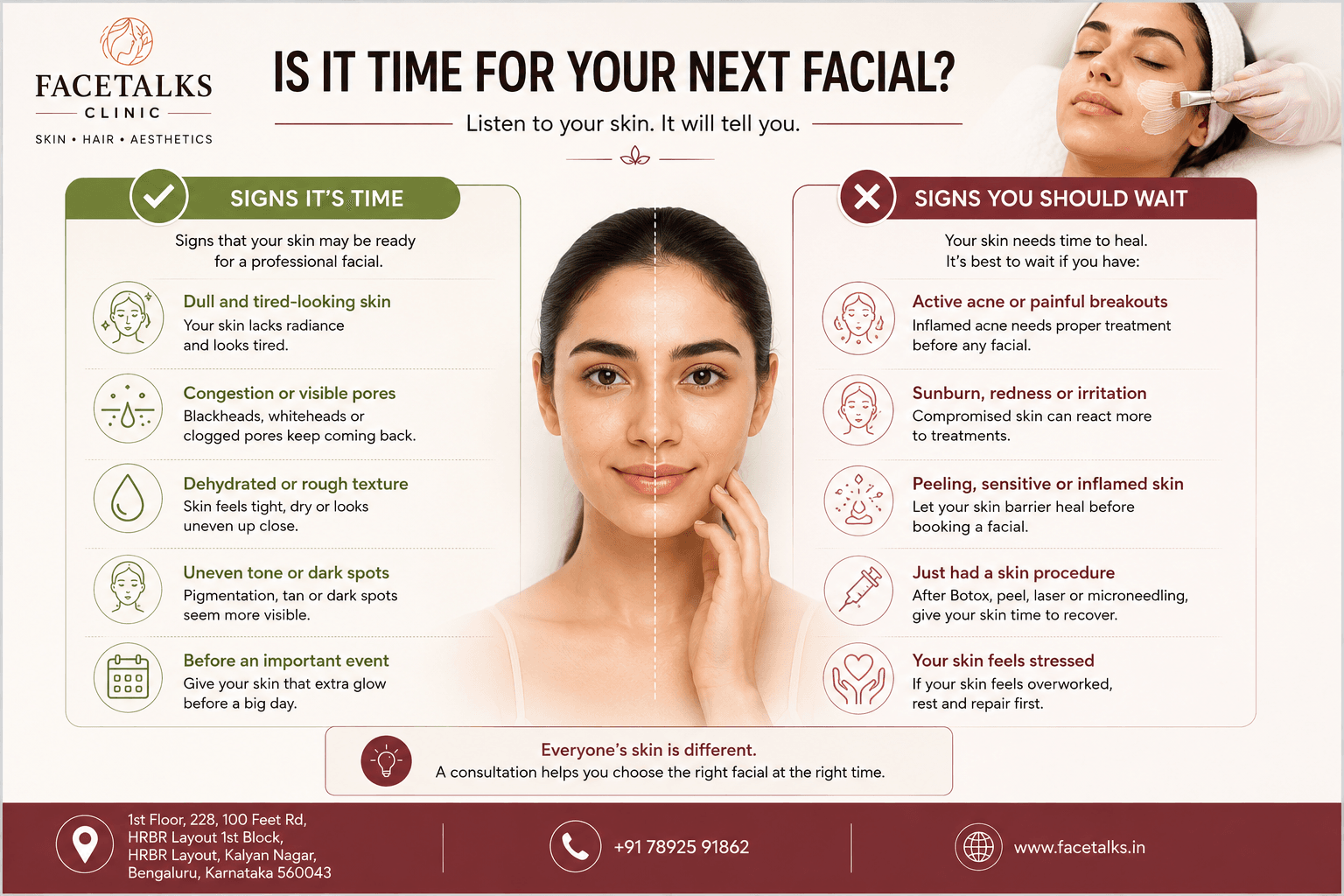 Instead of only watching the calendar, watch your skin.
You may consider another maintenance facial if:
- Your skin has returned to its usual dull appearance
- Congestion is building up again
- Your skin feels dehydrated
- You have an upcoming event
- You are following a professional treatment schedule
But postpone treatment and seek appropriate advice if your skin is:
- Irritated
- Sunburned
- Inflamed
- Peeling unusually
- Experiencing an unexplained rash
- Recovering from another procedure
Your skin doesn’t owe the calendar an appointment.
What Should You Do Between Facials?
This may actually matter more than facial frequency.
A simple daily routine can help maintain your results.
Cleanse gently
Avoid scrubbing your face aggressively.
Moisturise
Even oily skin may need appropriate hydration.
Use sunscreen
Daily sun protection is important for reducing UV damage and preventing pigmentation from worsening.
AAD recommends broad-spectrum sun protection as a basic component of routine skincare.
Avoid excessive exfoliation
If your professional facial already includes exfoliation, don’t immediately combine it with multiple strong acids and scrubs at home.
Follow your aftercare
Treatment-specific instructions should take priority over general skincare advice.
How to Build a Facial Schedule That Actually Makes Sense
Rather than purchasing a package first and figuring out why later, use this approach.
Step 1: Identify your skin type
Is your skin:
- Oily?
- Dry?
- Combination?
- Sensitive?
Step 2: Identify your main concern
Is the problem:
- Dullness?
- Dehydration?
- Congestion?
- Pigmentation?
- Acne?
- Texture?
Step 3: Choose the appropriate treatment
Don’t automatically select whatever facial is currently trending.
Step 4: See how your skin responds
Pay attention during the following days and weeks.
Step 5: Decide the next interval
If your skin responded well, your treatment professional can recommend whether to repeat it around four to six weeks later or wait longer.
That’s much more personalised than:
“Everyone needs one facial every month.”
Facial Treatment in Kalyan Nagar & HRBR Layout
If you are looking for professional facial treatments around Kalyan Nagar, HRBR Layout, Kammanahalli, Hennur or Banaswadi, Facetalks Clinic provides skin and aesthetic consultations at its HRBR Layout location.
Current facial options listed by FaceTalks include treatments such as:
- HydraFacial
- Korean Glass Facial
- Carbon Peel Facial
along with other skin and aesthetic procedures.
Instead of deciding how many sessions you need before anyone has assessed your skin, start with the concern.
A consultation can help determine:
Which facial → how often → what home care → when to review.
That order makes much more sense.
Frequently Asked Questions
How often should I get a professional facial?
For many people, around four to six weeks may be used as a general starting point, but there is no universal schedule. Frequency should depend on your skin type, skin concern, type of facial and how your skin responds.
Is getting a facial once a month good?
It can be appropriate for some people, particularly for general maintenance, but monthly facials aren’t compulsory for healthy skin.
Can I get a facial every two weeks?
That may be unnecessarily frequent for many people, particularly if the treatment involves exfoliation. Your treatment type and skin condition should determine the interval.
How often should I get HydraFacial?
Some people schedule HydraFacial roughly every four to six weeks for maintenance. Others need it less often. Your skin goals and response should determine frequency.
How often should oily skin get a facial?
Oily or congested skin may benefit from periodic professional cleansing, but aggressive or overly frequent exfoliation can irritate the skin. A personalised schedule is preferable.
How often should dry skin get a facial?
Dry skin may benefit from gentle hydration-focused treatments, but frequency should depend on skin-barrier health and how the skin responds.
Do I need a facial every month?
No. Monthly professional facials are an optional skincare-maintenance approach, not a requirement.
Is it okay to get facials when I have acne?
That depends on the acne. Mild congestion is different from active inflammatory or cystic acne. Persistent or painful acne should be properly assessed rather than relying solely on facials.
Where can I get a facial in Kalyan Nagar, Bangalore?
Facetalks Clinic offers skin and facial treatment consultations from its HRBR Layout location near Kalyan Nagar, Bengaluru.
So, How Often Should You Get a Facial?
There isn’t one correct number.
For some people:
Every 4–6 weeks works well.
For others:
Every couple of months is enough.
And some people simply choose professional facials before special occasions.
The better approach is to look at:
Your skin type + your concern + the treatment + your response.
Then decide when the next facial actually makes sense.
Book a Skin Consultation at Facetalks Clinic
Facetalks Clinic – HRBR Layout
1st Floor, 228, 100 Feet Rd
HRBR Layout 1st Block
Kalyan Nagar, Bengaluru, Karnataka 560043
Call / WhatsApp: +91 78925 91862
Author: Facetalks Clinic Editorial Team