

Pigmentation Treatment Bangalore: Dark Spots & Melasma
You notice a dark patch on your cheek.
Or acne finally settles, but the marks stay behind.
Maybe your skin tone has started looking uneven around the forehead, upper lip or cheeks even though you have tried brightening serums, facials and home remedies.
Pigmentation can be frustrating because not every dark mark has the same cause.
That is also why searching for the strongest peel or the most powerful laser is not necessarily the right starting point.
Before choosing a pigmentation treatment in Bangalore, it is important to understand what is causing the colour change in the first place.
Hyperpigmentation generally means that an area of skin has become darker than the surrounding skin because of increased pigment. Possible causes include sun exposure, previous acne or inflammation, melasma, hormonal influences, medication and other skin or medical conditions.
EXTERNAL-SOURCE: Cleveland Clinic — https://my.clevelandclinic.org/health/diseases/21885-hyperpigmentation
If you live around Kalyan Nagar, HRBR Layout, Kammanahalli, Hennur or Banaswadi and are considering professional pigmentation treatment, an assessment should come before choosing a procedure.
What Type of Pigmentation Do You Have?
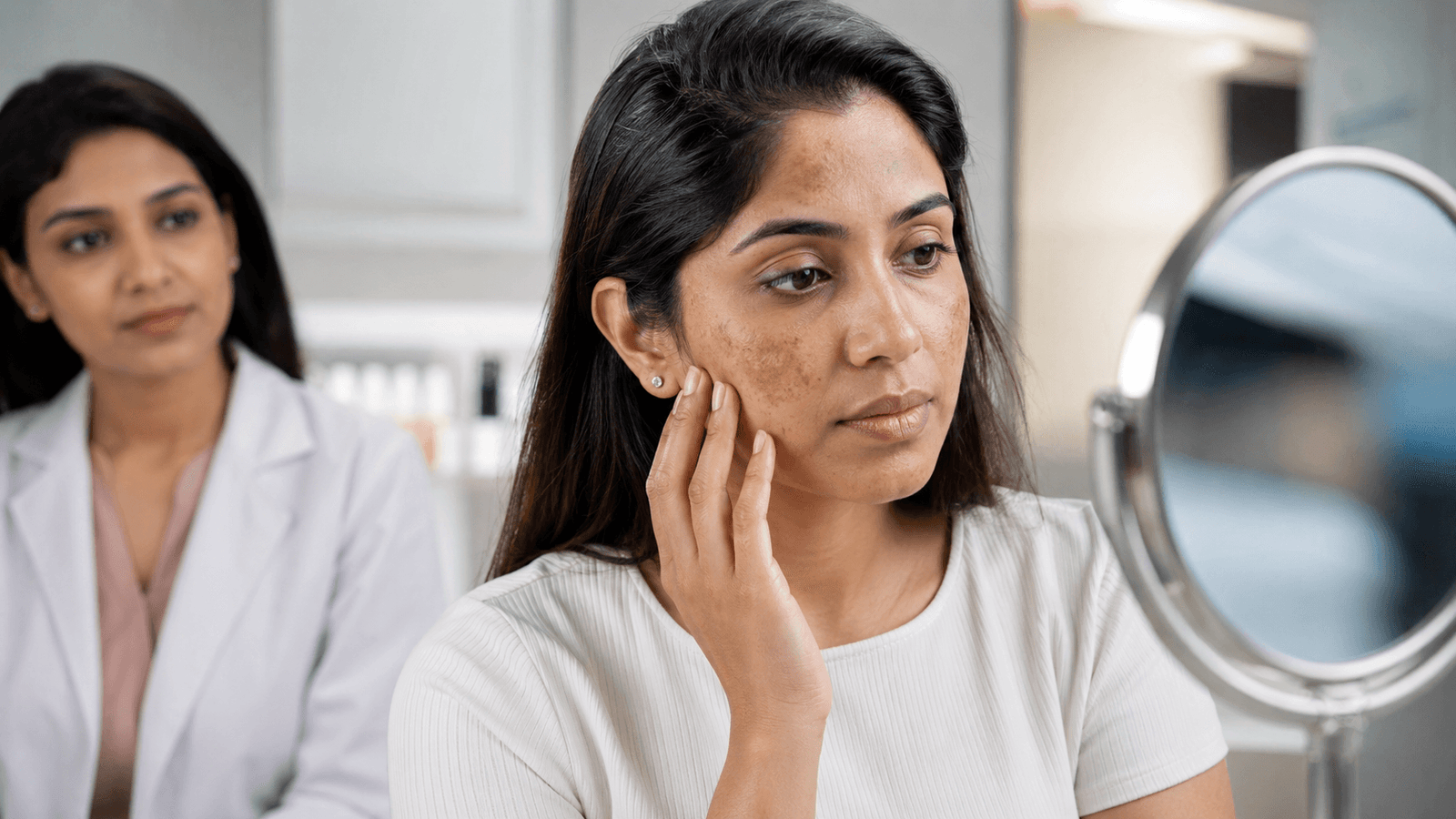
“Pigmentation” is a broad term.
Two people with similar-looking dark patches may need very different approaches.
Post-inflammatory hyperpigmentation after acne
After a pimple, irritation, burn or other inflammation settles, the skin may leave behind a brown, grey-brown or darker mark.
This is known as post-inflammatory hyperpigmentation, or PIH.
It is particularly relevant for people who are prone to pigmentation after acne or skin irritation.
Sun exposure may make these marks more noticeable, which is one reason daily sun protection remains an important part of management.
EXTERNAL-SOURCE: DermNet — https://dermnetnz.org/topics/postinflammatory-hyperpigmentation
If your concern is not simply flat dark marks but pits, depressions or uneven skin texture left after acne, you may be dealing with acne scars rather than pigmentation alone.
acne scar treatment in Bangalore
Melasma
Melasma commonly appears as patches of increased pigmentation, often on areas such as the cheeks, forehead, nose or upper lip.
Sunlight, hormonal factors and other triggers may contribute to it.
The important thing to understand is that melasma may behave differently from an ordinary superficial dark spot.
It can also recur or become darker when the skin is irritated.
For this reason, simply choosing an aggressive laser or peel without identifying the condition first may not be appropriate.
The American Academy of Dermatology notes that melasma treatment plans are usually customised according to factors such as skin tone, depth of pigment and possible triggers.
EXTERNAL-SOURCE: American Academy of Dermatology — https://www.aad.org/public/diseases/a-z/melasma-treatment
Sun-related pigmentation and tanning
Frequent ultraviolet exposure can contribute to tanning, uneven tone and some forms of pigmentation.
However, tanning and persistent pigmentation are not always the same problem.
If a dark patch remains despite your tan fading, or repeatedly returns in the same area, it is worth having the cause assessed rather than repeatedly booking de-tan facials.
Pigmentation that needs medical assessment
Not every change in skin colour should automatically be treated cosmetically.
Seek appropriate medical assessment if a pigmented area:
- Appears suddenly without an obvious explanation
- Is changing rapidly
- Has an unusual shape or colour
- Becomes painful, itchy or inflamed
- Bleeds or develops discharge
- Appears alongside other unexplained symptoms
The objective should be to understand the diagnosis first, not to immediately lighten every dark mark.
Can Skincare Help With Pigmentation?
Yes, skincare can be an important part of a pigmentation plan.
But the appropriate ingredients depend on what is causing the pigmentation and how sensitive your skin is.
Depending on the condition, professionally recommended skincare may include ingredients such as:
- Azelaic acid
- Vitamin C
- Niacinamide
- Retinoids
- Kojic acid
- Selected pigment-regulating ingredients
Prescription ingredients such as hydroquinone or tretinoin may also be used in some pigmentation treatment plans, but they should not be started casually simply because they appeared in a social-media recommendation.
EXTERNAL-SOURCE: Cleveland Clinic — https://my.clevelandclinic.org/health/diseases/21885-hyperpigmentation
More product is not automatically better.
Using multiple acids, scrubs and brightening products together can irritate the skin, and inflammation itself may make pigmentation more noticeable in people prone to PIH.
Sunscreen Is Part of Pigmentation Treatment
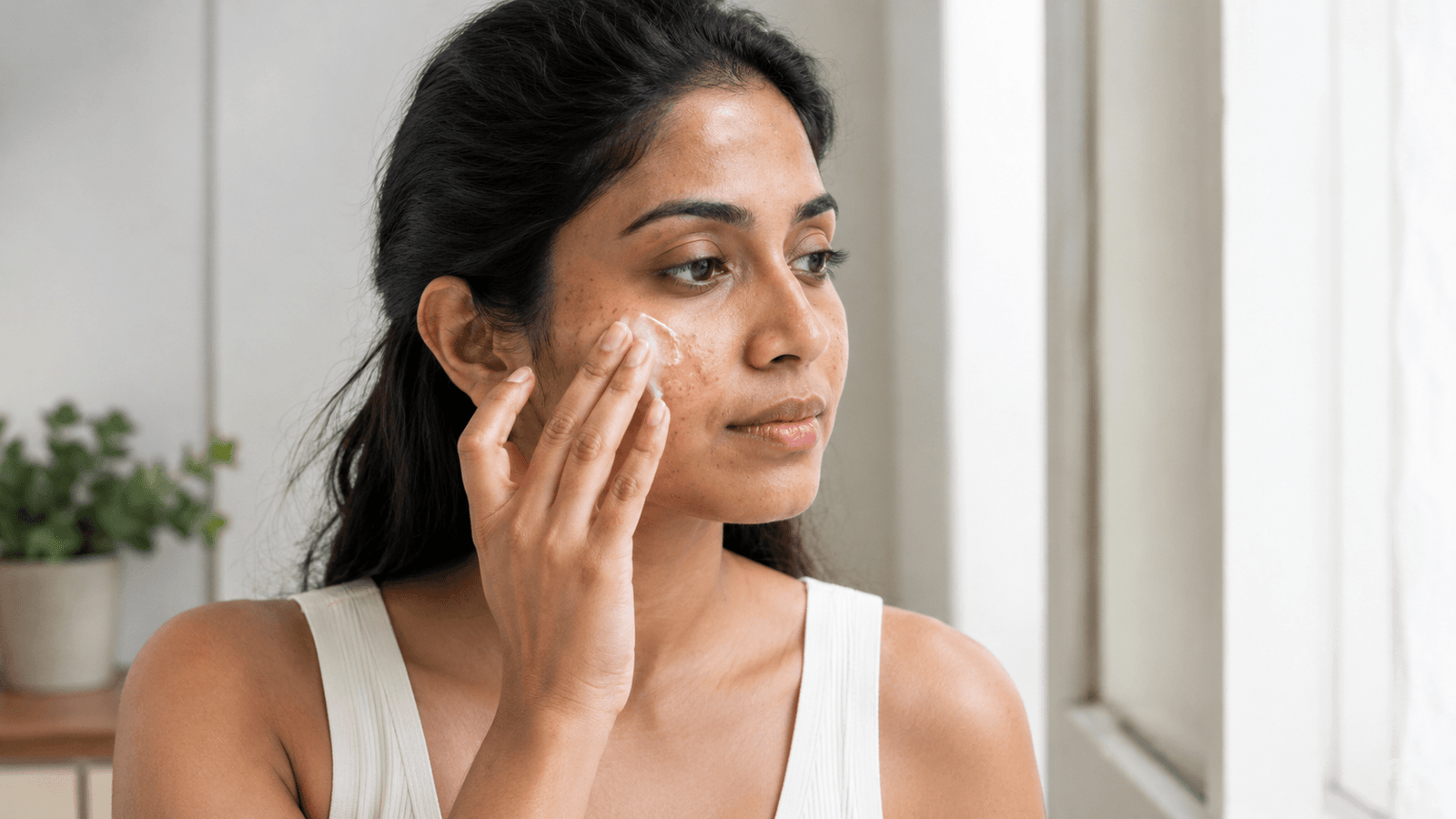
People sometimes focus completely on lasers, peels and serums while treating sunscreen as optional.
It is not.
Sun exposure can contribute to new pigmentation and darken pigmentation that is already present.
The American Academy of Dermatology recommends broad-spectrum SPF 30 or higher as part of melasma care and also discusses tinted sunscreen containing iron oxide for people dealing with certain pigmentation concerns.
EXTERNAL-SOURCE: American Academy of Dermatology — https://www.aad.org/public/diseases/a-z/melasma-treatment
EXTERNAL-SOURCE: American Academy of Dermatology — https://www.aad.org/public/everyday-care/skin-care-secrets/routine/fade-dark-spots
For someone travelling regularly through Bangalore traffic, walking during the afternoon or spending time near windows, consistent sun protection can matter just as much as what happens during a clinic appointment.
Treatment without prevention may make the overall plan less useful.
Chemical Peels for Pigmentation
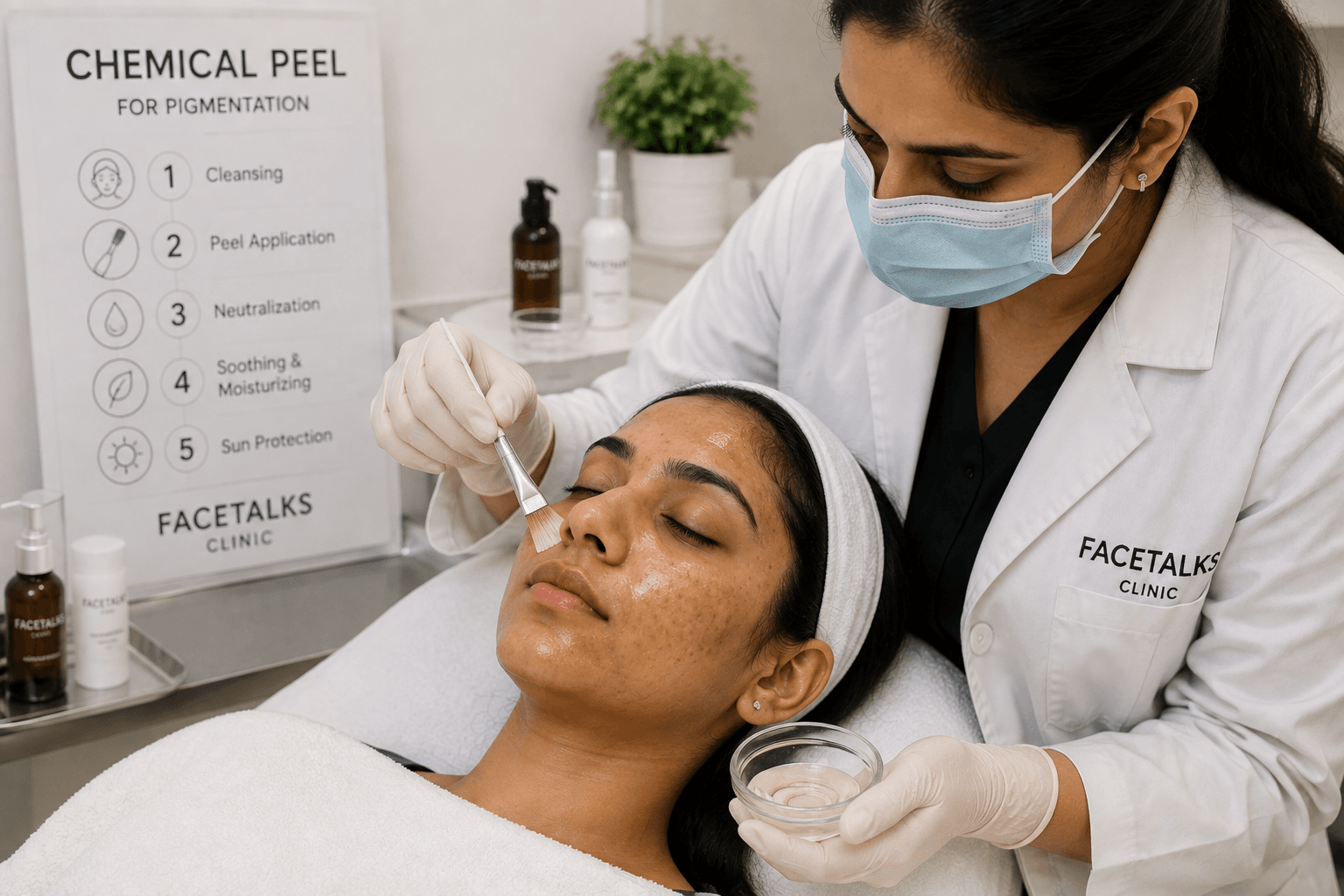
non-surgical facial treatments
Chemical peels use selected exfoliating agents to remove or loosen superficial layers of skin.
Depending on the type of pigmentation, skin type and peel selected, they may be considered as one part of a pigmentation treatment plan.
Different peels have different strengths and purposes.
Commonly used professional peeling agents may include glycolic, salicylic, lactic or other acids depending on the indication.
Chemical peels may help improve the appearance of some forms of superficial pigmentation, but stronger does not automatically mean better.
In pigmentation-prone skin, excessive irritation can sometimes cause further post-inflammatory pigmentation.
EXTERNAL-SOURCE: DermNet — https://dermnetnz.org/topics/postinflammatory-hyperpigmentation
This is why the peel should be selected according to the skin rather than simply choosing the highest concentration available.
Pico Laser and Other Laser Treatments for Pigmentation
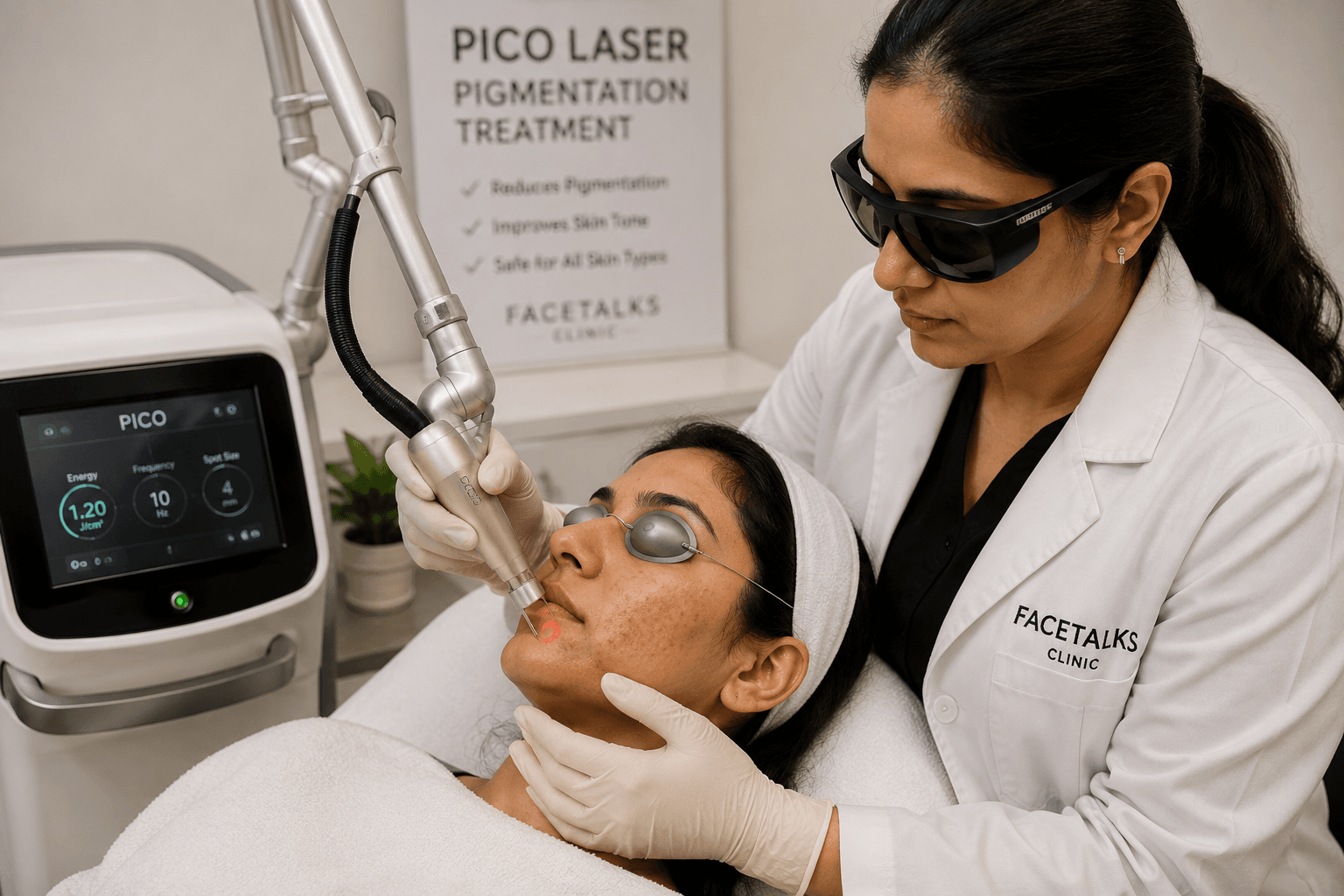
Laser-based procedures may be considered for selected pigmentation concerns.
Pico Laser is one option people frequently search for when dealing with dark spots and uneven pigmentation.
The laser delivers energy in very short pulses with the aim of targeting selected pigment.
But there is an important distinction:
Having pigmentation does not automatically mean you need Pico Laser.
Your skin tone, type of pigmentation, depth of pigment, recent tanning, previous procedures and tendency to develop post-inflammatory pigmentation can all influence treatment planning.
DermNet notes that laser treatments may be useful for some forms of pigmentation but can also aggravate pigmentation through skin injury in some cases.
EXTERNAL-SOURCE: DermNet — https://dermnetnz.org/topics/postinflammatory-hyperpigmentation
For melasma specifically, lasers and chemical peels require careful patient selection because the condition may recur or worsen in some circumstances.
EXTERNAL-SOURCE: DermNet — https://dermnetnz.org/topics/melasma
So if someone recommends a laser before asking what type of pigmentation you have, it is reasonable to ask more questions.
Chemical Peel or Pico Laser: Which Should You Choose?
There is no universal winner.
A superficial pigmentation concern may be approached differently from deeper pigment.
Post-acne marks may need a different plan from melasma.
Someone with sensitive or recently irritated skin may need to stabilise the skin before undergoing any procedure.
A proper treatment decision may consider:
- What is causing the pigmentation
- How deep the pigment appears to be
- Your skin tone
- Current skin sensitivity
- History of acne or inflammation
- Current skincare products
- Previous laser or peel treatments
- Recent sun exposure or tanning
- How quickly the pigmentation tends to return
In some cases, a combination of skincare, sun protection and clinic-based procedures may be considered rather than relying on one treatment alone.
Can a Facial Remove Pigmentation?
A regular facial may help your skin feel cleaner, hydrated or temporarily brighter.
But persistent dark patches are different from ordinary dullness.
If the problem is melasma, post-acne pigmentation or another pigmentary condition, repeatedly booking a “brightening facial” without understanding the cause may not address the actual concern.
This is also where pigmentation treatment differs from choosing a facial simply based on skin type.
If pigmentation is your main concern, start with the pigmentation rather than the facial name.
choosing a facial for your skin type
How Long Does Pigmentation Take to Improve?
There is no responsible single timeline for every pigmentation concern.
Some superficial dark marks gradually fade as the skin recovers, while deeper pigmentation or melasma may take considerably longer and may require ongoing management.
The American Academy of Dermatology notes that some post-inflammatory dark spots can take months to fade naturally, while deeper discolouration may take longer.
EXTERNAL-SOURCE: American Academy of Dermatology — https://www.aad.org/public/everyday-care/skin-care-secrets/routine/fade-dark-spots
The practical framework is:
- Identify the type of pigmentation.
- Control triggers such as unnecessary irritation and sun exposure.
- Start an appropriate home-care or treatment plan.
- Review how the skin responds.
- Adjust the plan rather than repeatedly increasing treatment intensity.
Pigmentation treatment should usually be thought of as a process rather than a one-session promise.
How Much Does Pigmentation Treatment Cost in Bangalore?
The final cost can vary according to the diagnosis and treatment chosen.
For example, a pigmentation plan based mainly on skincare will have a different cost structure from a plan involving chemical peels, Pico Laser or a combination of procedures.
Before publishing this article, Facetalks Clinic should provide the current genuine price range for:
- Pigmentation consultation, if charged
- Chemical peel sessions
- Pico Laser pigmentation treatment
- Relevant pigmentation packages, if available
Do not replace this section with a generic “contact us for pricing” statement. A real current range should be inserted before publication.
What to Avoid When Treating Dark Spots
Pigmentation is one of those concerns where trying to fix the skin too aggressively may create a second problem.
Be cautious about:
- Using strong acids every day without guidance
- Scrubbing dark marks aggressively
- Picking acne lesions
- Combining several active ingredients at once
- Using prescription pigmentation creams without appropriate guidance
- Choosing a laser only because it is trending
- Undergoing aggressive procedures immediately before a wedding or major event
- Ignoring sunscreen while spending money on pigmentation procedures
- Expecting every pigmentation type to respond to the same treatment
If a treatment plan sounds too simple for a complicated pigmentation problem, ask what diagnosis the plan is actually based on.
Pigmentation Treatment at Facetalks Clinic in Kalyan Nagar & HRBR Layout
If you live around Kalyan Nagar, HRBR Layout, Kammanahalli, Hennur, Banaswadi or nearby parts of Bengaluru, Facetalks Clinic provides consultations for non-surgical facial and pigmentation concerns.
Depending on your assessment, options discussed may include skincare guidance, selected chemical peels, Pico Laser or other non-surgical aesthetic procedures.
The aim should not be to automatically recommend the strongest available procedure.
It should be to understand:
What is causing the pigmentation, what your skin can safely tolerate and what level of improvement is realistic for your individual concern.
Facetalks Clinic – HRBR Layout
1st Floor, 228, 100 Feet Rd, HRBR Layout 1st Block, Kalyan Nagar, Bengaluru, Karnataka 560043
Call / WhatsApp: +91 78925 91862
[INTERNAL-LINK: Book Your Consultation → /contact-us/]
Frequently Asked Questions
What is the most suitable treatment for facial pigmentation?
There is no single pigmentation treatment that suits everyone. The appropriate option depends on whether the pigmentation is caused by acne, melasma, sun exposure, inflammation or another condition. Skincare, chemical peels, Pico Laser or a combination may be considered after assessment.
Can Pico Laser remove pigmentation?
Pico Laser may help improve the appearance of selected pigment concerns, but it is not automatically appropriate for every dark spot or every skin type. The cause and depth of pigmentation should be considered before choosing laser treatment.
Can chemical peels help with dark spots?
Selected chemical peels may help improve some forms of superficial pigmentation by exfoliating the upper layers of skin. However, the peel type and strength should be selected carefully because excessive irritation may contribute to post-inflammatory pigmentation.
Can acne pigmentation go away on its own?
Some post-acne dark marks can gradually fade over time, but the timeline varies according to pigment depth, skin tone, sun exposure and repeated inflammation. Sun protection and an appropriate skincare plan may help support improvement.
melasma the same as normal pigmentation?
Melasma is a specific pigmentary condition and may be influenced by sunlight, hormones and other triggers. It can behave differently from a simple post-acne mark or superficial sun spot, so treatment plans should be individualised.
Does sunscreen actually help pigmentation?
Sun protection is an important part of pigmentation management because ultraviolet and visible light can contribute to darkening in some pigmentation conditions. Broad-spectrum sunscreen should generally remain part of the plan even when clinic procedures are being performed.
Where can I get pigmentation treatment near Kalyan Nagar?
Facetalks Clinic is located at HRBR Layout 1st Block, Kalyan Nagar, Bengaluru and provides consultations for pigmentation and other non-surgical facial concerns. Patients from Kammanahalli, Hennur and Banaswadi can also access the clinic from nearby areas.
Written by the Facetalks Clinic Editorial Team.