
HydraFacial vs Traditional Facial in Bangalore: Which Is Better for Your Skin?
You want your skin to look fresher before a wedding, function, holiday or simply because it has started looking tired.
You open Instagram or Google and immediately run into two very different options.
A regular facial that you may already be familiar with.
And HydraFacial, which seems to be everywhere.
At first glance, both sound similar.
Both involve cleansing the face. Both may include exfoliation and hydration. Both are generally chosen to make the skin look fresher.
So why does HydraFacial usually cost more?
And more importantly:
Is HydraFacial actually better than a traditional facial?
The answer depends on what your skin needs.
Let’s break down the differences without the marketing hype.
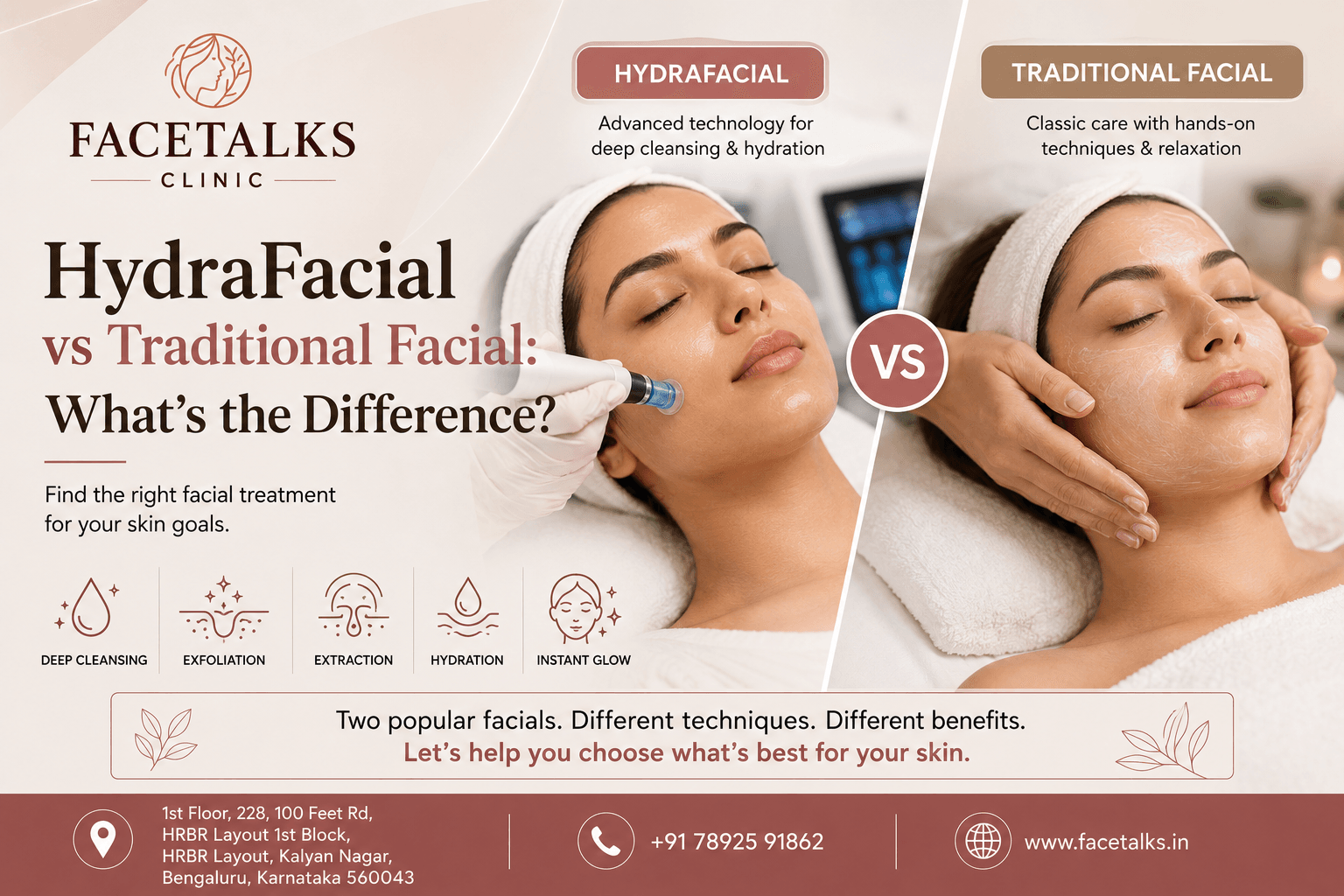
 What Is a Traditional Facial?
 What Is a Traditional Facial?
A traditional facial is usually a combination of several manual skincare steps performed according to your skin type and the facial protocol being used.
A typical facial may include:
- Cleansing
- Exfoliation
- Steam
- Blackhead or whitehead extraction where appropriate
- Facial massage
- Face mask
- Moisturiser
- Sunscreen
The exact steps vary significantly between clinics, salons and facial types.
For example, a hydrating facial for dry skin may be very different from a deep-cleansing facial designed for oily or congested skin.
That flexibility is one of the advantages of a traditional facial.
The treatment can often be adjusted according to whether the skin feels oily, dry, dull or dehydrated.
What Is a HydraFacial?
HydraFacial is a device-assisted facial treatment.
Instead of relying mainly on manual exfoliation and product application, the treatment uses a specialised handpiece to perform different stages of the facial.
HydraFacial is commonly described as a form of hydradermabrasion.
Depending on the protocol, treatment generally combines:
- Cleansing
- Exfoliation
- Suction-assisted removal of surface debris
- Hydration
- Application of selected skincare solutions or serums
The treatment is designed to perform several facial steps in a controlled, device-assisted process.
Published research on hydradermabrasion has reported improvements in measures such as skin hydration, smoothness and radiance, although studies are relatively small and results can vary between devices, treatment protocols and individuals.
So HydraFacial should not be viewed as a magical treatment.
It is simply a different approach to professional facial care.
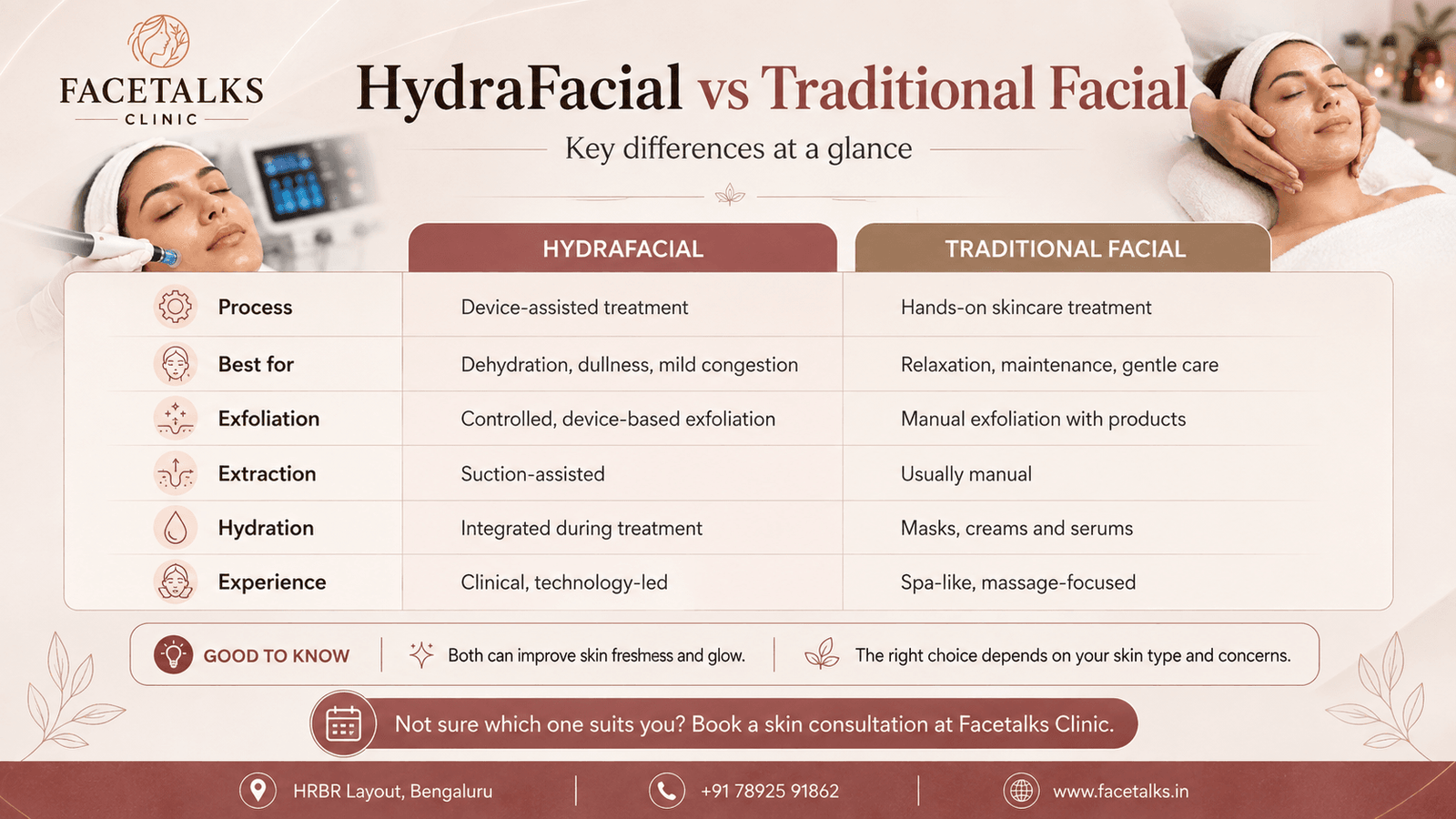
HydraFacial vs Traditional Facial: Quick Comparison
| Feature | HydraFacial | Traditional Facial |
|---|---|---|
| Cleansing | Device assisted | Usually manual |
| Exfoliation | Controlled device-based exfoliation | Scrubs, enzymes or other exfoliating methods depending on facial |
| Extraction | Suction-assisted in suitable areas | Usually manual when required |
| Hydration | Delivered during treatment using the facial system | Masks, creams, serums and moisturisers |
| Massage | Not always the main focus | Often an important part |
| Customisation | Boosters/solutions and settings may be adjusted | Products and techniques may be adjusted |
| Typical experience | Clinical, device-assisted facial | More traditional spa-style facial experience |
| Downtime | Usually minimal for suitable skin | Usually minimal for gentle facials |
| Best choice | Depends on skin concern | Depends on skin concern |
Neither automatically wins.
It depends on what you expect from the treatment.
 1. The Cleansing Process Is Different
 1. The Cleansing Process Is Different
Traditional facials normally begin with manual cleansing.
The therapist or treatment professional uses cleansers and other products to remove:
- Makeup
- Sunscreen
- Excess oil
- Surface dirt
HydraFacial also begins with cleansing, but much of the treatment is performed through its specialised handpiece.
For someone who enjoys a technology-led facial experience, HydraFacial may feel more systematic.
For someone who prefers hands-on skincare and facial massage, a traditional facial may be more enjoyable.
2. HydraFacial Uses Device-Assisted Exfoliation
Exfoliation removes some of the dead cells sitting on the outermost surface of the skin.
A traditional facial may use:
- Gentle scrubs
- Enzymes
- Selected exfoliating products
- Other superficial exfoliation techniques
HydraFacial performs exfoliation through its treatment tip and fluid-based system.
The aim is to remove surface buildup while continuing with cleansing and hydration.
This is one of the main reasons people notice that their skin feels smoother immediately after treatment.
But more exfoliation is not necessarily better.
Over-exfoliating sensitive or irritated skin can be counterproductive.
The intensity should always suit the skin being treated.
3. Extraction Is Another Major Difference
Blackheads and congestion are one of the main reasons people get professional facials.
During many traditional facials, extractions are performed manually.
That means pressure may be applied around selected clogged pores to clear them.
HydraFacial uses suction during the treatment process to assist with removing surface debris and congestion.
Some people prefer this because it feels different from traditional manual extraction.
However, neither technique means that every pore needs to be aggressively emptied.
Trying to force deeply inflamed or inappropriate lesions can irritate the skin.
If you have significant acne rather than occasional congestion, treating the acne itself may be more important than repeatedly extracting the pores.
4. HydraFacial Places More Emphasis on Hydration
Hydration is one of the reasons HydraFacial became popular.
After cleansing and exfoliation, the system can deliver selected hydrating solutions onto the skin.
Traditional facials can also hydrate the skin through:
- Serums
- Masks
- Moisturisers
- Massage products
So hydration is not unique to HydraFacial.
The difference is mainly how the products are incorporated into the treatment.
If your primary complaint is that your skin looks tired, feels dehydrated or lacks freshness, either treatment may potentially be suitable depending on your skin assessment.
5. Traditional Facial Usually Gives You More Massage
This is an area where a traditional facial may have the advantage.
If what you enjoy most is:
- Facial massage
- Relaxation
- A spa-like experience
- Masks
- Manual skincare
you may actually prefer a traditional facial.
HydraFacial tends to be more treatment-oriented.
The device and treatment steps are the focus.
That does not make one better.
They simply provide different experiences.
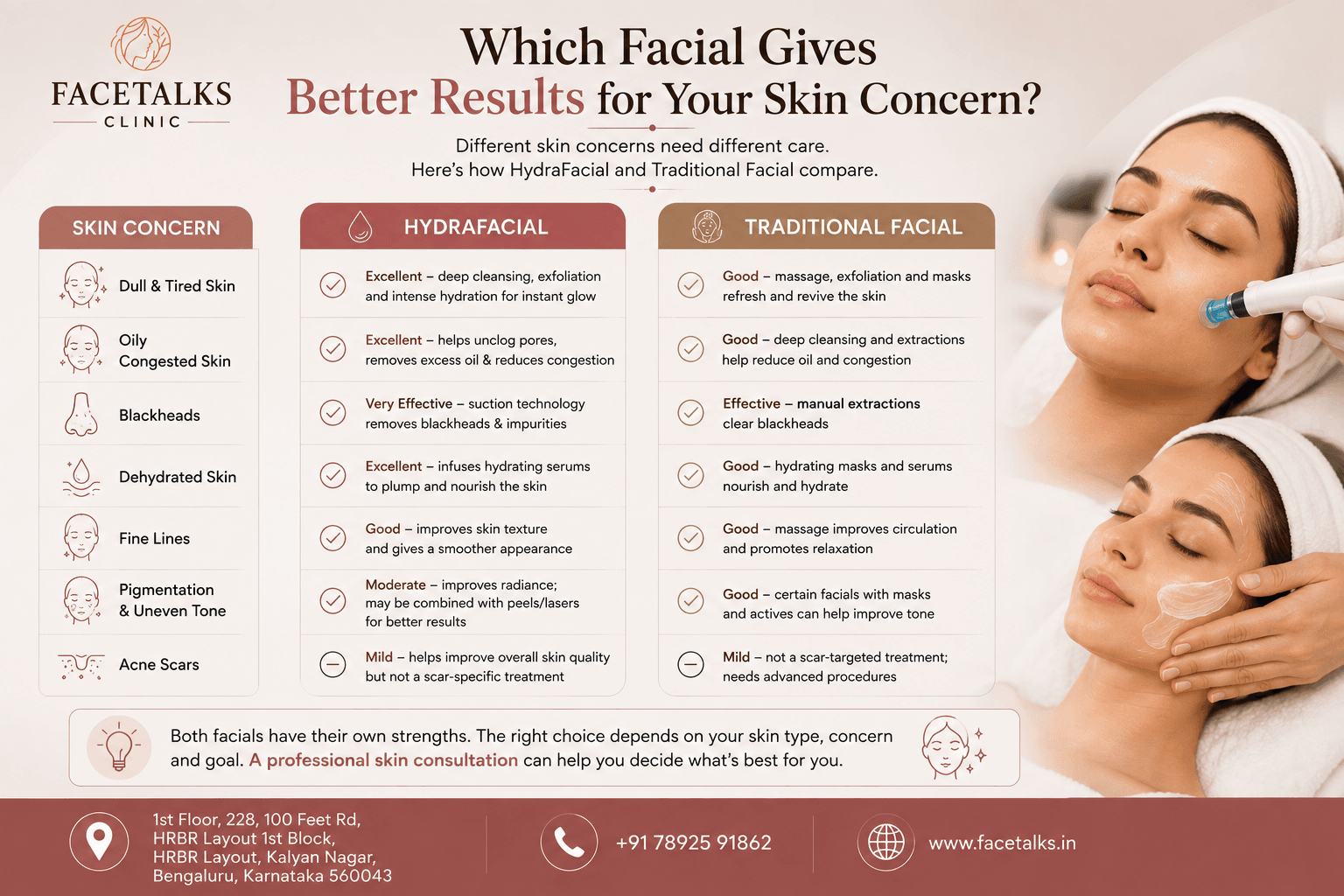
Is HydraFacial Better for Oily Skin?
It can be a useful option for certain people with oily or congested-looking skin because the treatment combines cleansing, exfoliation and suction.
You may consider a HydraFacial if you commonly notice:
- Oily appearance
- Surface congestion
- Blackheads
- Dullness
- Rough-feeling texture
But oily skin does not automatically mean HydraFacial is the right treatment.
Someone with active inflammatory acne, for example, may need a different approach.
If breakouts are painful, persistent or leaving scars, getting the acne assessed should take priority over simply booking facials.
Is HydraFacial Good for Dry Skin?
HydraFacial is often chosen by people whose skin feels dehydrated or looks dull because hydration is an important part of the treatment.
However, there is an important difference between dry skin and dehydrated skin.
Dry skin generally produces less oil.
Dehydrated skin lacks sufficient water.
Even oily skin can become dehydrated.
If your skin is extremely dry, irritated or sensitive, the treatment settings and products need to be selected carefully.
A gentle hydrating facial may sometimes be more appropriate.
What About Sensitive Skin?
Sensitive skin deserves more caution.
If your skin regularly becomes:
- Red
- Itchy
- Irritated
- Reactive
- Uncomfortable after exfoliation
tell the clinic before treatment begins.
A facial should not become a competition to see how much exfoliation your skin can tolerate.
For sensitive skin, gentler treatment may be preferable.
If you currently have unexplained redness, irritation, broken skin or a rash, it is better to have the skin evaluated before undergoing a cosmetic facial.
HydraFacial for Dull Skin
Dull-looking skin is probably one of the most common reasons people book HydraFacial.
Skin can appear dull due to several factors, including:
- Dehydration
- Surface buildup
- Dryness
- Sun exposure
- Irregular skincare
- Lack of sleep
- Uneven pigmentation
Cleansing, exfoliation and hydration may temporarily make the complexion look fresher and smoother.
But there is an important limitation.
If your “dullness” is actually caused by significant pigmentation, tanning or melasma, a facial alone may not address the underlying issue.
You may need a separate pigmentation-focused treatment plan.
Can HydraFacial Remove Pigmentation?
This is where expectations need to stay realistic.
A HydraFacial may improve the overall appearance of the skin and help it look fresher.
But persistent pigmentation is more complicated.
Dark spots can be associated with:
- Post-acne pigmentation
- Sun exposure
- Tanning
- Melasma
- Previous skin inflammation
Depending on the cause, treatments such as professional skincare, chemical peels or selected laser-based procedures may be considered.
So if pigmentation is your primary concern, don’t automatically book HydraFacial simply because it is described as a “brightening” treatment.
Get the pigmentation assessed first.
Can HydraFacial Treat Acne Scars?
HydraFacial should not be confused with acne-scar procedures.
Deep acne scars involve structural changes in the skin.
They may include:
- Ice-pick scars
- Boxcar scars
- Rolling scars
- Raised scars
Treatments aimed at acne scars may include procedures such as:
- Microneedling
- MNRF
- Selected laser treatments
- Other scar-specific approaches
HydraFacial may improve surface cleanliness, hydration and overall appearance, but it should not be presented as a replacement for deeper acne-scar treatment.
Which Gives More Glow: HydraFacial or Traditional Facial?
This is probably what most people actually want to know.
Both can make skin look fresher.
The difference lies in the treatment approach.
A good traditional facial may produce visibly refreshed skin through:
- Cleansing
- Exfoliation
- Massage
- Hydration
- Mask application
HydraFacial uses device-assisted cleansing, exfoliation and hydration.
The final appearance depends on:
- Your starting skin condition
- Your skin type
- Products used
- Treatment intensity
- Hydration level
- Your home skincare routine
So don’t choose based purely on dramatic social-media before-and-after videos.
Those results don’t tell you how your own skin will respond.
HydraFacial Before a Wedding: Is It a Good Idea?
HydraFacial is often considered before weddings, engagements and other important events because people generally want something that gives the skin a fresher appearance without significant recovery time.
If you are preparing for an event, however, don’t wait until the last possible moment to experiment.
Tell the clinic:
- Your event date
- Whether you have had HydraFacial before
- Whether your skin is sensitive
- Any recent procedures
- Products or prescription skincare you use
Trying any unfamiliar facial immediately before an important event carries a possibility of temporary irritation or an unexpected reaction.
Planning ahead is safer.
How Long Does a HydraFacial Take?
The exact time depends on the treatment protocol and any additional steps.
In many clinics, a HydraFacial appointment is designed to fit relatively easily into the day compared with procedures requiring significant recovery.
But treatment time should not be your main deciding factor.
The more important question is:
Does your skin actually need the treatment?
Is There Downtime After HydraFacial?
Many people experience little interruption to their normal routine after a standard HydraFacial.
Temporary redness or sensitivity can still occur, depending on:
- Skin sensitivity
- Treatment intensity
- Products used
- Recent skincare
- Other treatments
Never assume that “no downtime” means your skin cannot react.
Your provider should tell you what to expect based on the actual treatment being performed.
How Long Do HydraFacial Results Last?
There is no fixed duration that applies to every person.
Skin appearance changes continuously due to:
- Oil production
- Skin-cell turnover
- Sun exposure
- Skincare habits
- Hydration
- Environment
- Lifestyle
The fresh appearance after a facial is therefore not permanent.
Some people choose professional facials periodically as part of their skincare routine.
Others only book them before occasions.
There is no rule saying everyone needs a HydraFacial every month.
Treatment frequency should make sense for your skin and budget.
How Often Should You Get a HydraFacial?
You may often hear recommendations to schedule HydraFacial every four weeks.
That doesn’t mean every person needs exactly the same schedule.
Frequency should depend on:
- Your skin type
- Your goals
- Your home routine
- Other treatments
- Skin sensitivity
- Your budget
For general maintenance, your provider can suggest an interval based on how your skin responds rather than automatically selling a fixed package.
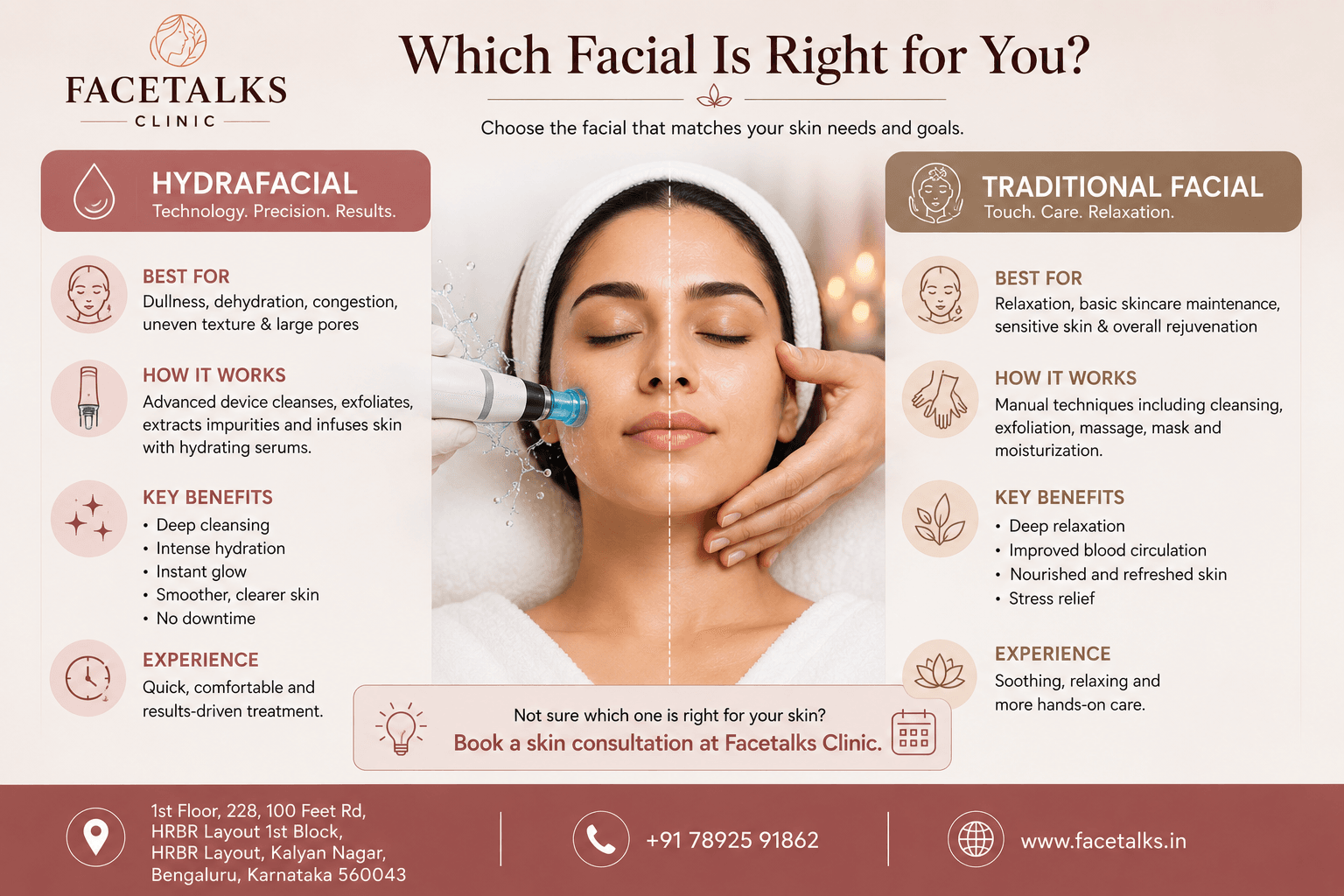
HydraFacial vs Traditional Facial: Which Is Better Before an Event?
If your priority is a technology-assisted treatment focused on cleansing, exfoliation and hydration, you may prefer HydraFacial.
If you mainly want:
- Relaxation
- Massage
- A customised mask
- Traditional facial care
you may prefer a traditional facial.
Some people may enjoy alternating treatments depending on their needs.
There isn’t one correct answer for everyone.
When Should You Choose HydraFacial?
HydraFacial may be worth considering if you:
- Prefer device-assisted facial treatment
- Want cleansing and hydration in the same session
- Have mildly congested-looking skin
- Have dehydrated or dull-looking skin
- Want a facial with usually limited recovery time
- Prefer less emphasis on traditional facial massage
When Might a Traditional Facial Be Better?
A traditional facial may make more sense if you:
- Primarily want relaxation
- Enjoy facial massage
- Want a gentle hydrating treatment
- Prefer manual skincare
- Have skin that does not need intensive exfoliation
- Want a simpler facial-maintenance routine
A good traditional facial is not automatically inferior simply because it uses less technology.
HydraFacial vs Korean Glass Facial: Are They the Same?
No.
These terms are often used together in clinic menus, which can create confusion.
HydraFacial refers to a specific device-assisted facial approach.
A Korean Glass Facial generally refers to a facial protocol focused on creating a smooth, hydrated and luminous appearance inspired by the “glass skin” aesthetic.
The actual steps of a Korean facial can vary between clinics.
If you’re choosing between them, ask exactly:
- What products are being used?
- What devices are included?
- What is the treatment supposed to improve?
- Is it appropriate for your skin?
Treatment names alone don’t tell you everything.
How Much Does HydraFacial Cost in Bangalore?
HydraFacial pricing in Bangalore varies between clinics.
Cost can depend on:
- Type of HydraFacial
- Treatment duration
- Products or boosters used
- Additional procedures
- Clinic infrastructure
- Professional expertise
- Packages or promotions
Instead of choosing purely based on the lowest advertised price, ask exactly what is included.
Two treatments called “HydraFacial” may not necessarily follow an identical protocol.
What Should You Ask Before Booking?
Whether you’re choosing HydraFacial or a traditional facial, ask these questions:
What is my skin type?
Your treatment should start with understanding your skin rather than automatically selecting the most expensive facial.
What concern is this treatment addressing?
Ask whether the treatment is primarily targeting hydration, congestion, dullness or another concern.
What products will be used?
This matters especially if you have sensitive skin or known allergies.
What should I avoid afterwards?
Proper aftercare can help reduce unnecessary irritation.
Is there a better treatment for my actual concern?
If your main problem is acne scars, melasma or significant pigmentation, a facial may not be the most appropriate first choice.
A responsible consultation should tell you that.
HydraFacial in Kalyan Nagar & HRBR Layout, Bangalore
If you’re searching for a HydraFacial near Kalyan Nagar, HRBR Layout, Kammanahalli, Hennur, Banaswadi or nearby Bangalore areas, Facetalks Clinic provides facial and aesthetic skin consultations at its HRBR Layout clinic.
FaceTalks offers facial options including treatments such as:
- HydraFacial
- Korean Glass Facial
- Carbon Peel Facial
- Other customised facial and aesthetic procedures
Rather than booking solely by treatment name, you can start by explaining what bothers you about your skin.
Is it:
- Dullness?
- Dryness?
- Oiliness?
- Congestion?
- Pigmentation?
- Acne?
- Uneven texture?
- Dehydration?
That information makes it easier to decide whether HydraFacial, a traditional facial or another procedure is more appropriate.
HydraFacial vs Traditional Facial: Final Verdict
So, which is better?
HydraFacial isn’t automatically better simply because it uses a machine.
And a traditional facial isn’t outdated simply because it relies more on manual techniques.
Choose HydraFacial when you want a device-assisted combination of cleansing, exfoliation and hydration.
Choose a traditional facial when you prefer a more hands-on, relaxing and customisable facial experience.
But if your main concern is something deeper—such as acne scars, persistent pigmentation or active acne—the better answer might be neither.
Start by understanding the condition of your skin.
Then choose the treatment.
Not the other way around.
Frequently Asked Questions
Is HydraFacial better than a normal facial?
Not necessarily. HydraFacial uses a device-assisted approach for cleansing, exfoliation and hydration, while traditional facials often rely more on manual techniques, massage, masks and skincare products. The best option depends on your skin and goals.
Does HydraFacial give instant glow?
Many people notice that their skin looks fresher and feels smoother after treatment because cleansing, exfoliation and hydration occur during the session. Results vary between individuals.
Is HydraFacial painful?
HydraFacial is generally designed as a relatively comfortable facial treatment. Sensation can vary depending on the settings, skin sensitivity and treatment areas.
Can HydraFacial remove blackheads?
The treatment uses suction that may help clear some surface congestion and blackheads. Deep or inflamed acne should not simply be aggressively extracted.
Is HydraFacial suitable for sensitive skin?
Some protocols can be adjusted, but sensitive skin should be assessed first. People with active irritation, rashes or highly reactive skin should tell the treatment provider before undergoing a facial.
Is HydraFacial good for acne scars?
HydraFacial may improve overall surface appearance but is not generally considered a replacement for scar-focused procedures such as microneedling, MNRF or selected laser treatments.
Can I wear makeup after HydraFacial?
Aftercare recommendations can vary depending on the treatment and individual skin response. Follow the advice provided by your treatment professional.
How often should I get HydraFacial?
There is no universal schedule. Frequency depends on your skin type, goals, sensitivity, home skincare routine and other treatments.
Where can I get HydraFacial in Kalyan Nagar?
Facetalks Clinic provides HydraFacial and other aesthetic facial treatments at its HRBR Layout clinic near Kalyan Nagar, Bengaluru.
Not Sure Which Facial Is Right for You?
Instead of trying to decide between HydraFacial and a traditional facial from photos online, start with your skin.
A consultation can help identify whether your main concern is:
- Dehydration
- Dullness
- Congestion
- Oiliness
- Pigmentation
- Acne
- Texture
From there, an appropriate facial or skin treatment can be discussed.
Book a Skin Consultation at Facetalks Clinic
Facetalks Clinic – HRBR Layout
1st Floor, 228, 100 Feet Rd
HRBR Layout 1st Block
Kalyan Nagar, Bengaluru, Karnataka 560043
Call / WhatsApp: +91 78925 91862
Author: Facetalks Clinic Editorial Team